Subscription growth at scale
I led growth design for HPlus at HungerStation, turning a cardless trial-expiry problem into a multi-touchpoint reactivation system that helped scale daily subscription registrations from 600-800 to about 5,000.
Millions of free trials had no renewal mandate.
HungerStation distributed free HPlus subscriptions quickly in response to Keeta’s market entry. Those users received the benefit, but many had no card or recurring payment authorization attached.
Make renewal part of the active order journey.
I led the design of a reactivation system across home, restaurant details, cart, and checkout, then worked across squads to make the payment model possible.
From 600-800 to about 5,000 registrations a day.
Offer periods peaked near 12,500-15,000 daily reactivations, while the subscription program generated €80Mn+ annually.
The free trial solved one problem and created another.
When Keeta entered Saudi Arabia with free delivery, HungerStation responded by automatically giving new, churned, and at-risk users three, six, or twelve months of HPlus. It stabilized the business quickly and increased ordering from those cohorts.
The catch was structural: the urgent rollout skipped the normal activation flow. As those trials expired, we needed to convert users who had experienced HPlus but had never approved recurring billing.
I moved HPlus renewal out of settings and into moments of intent.
Users rarely open an account page to manage a subscription. I designed a set of contextual entry points that connected HPlus to the order they were already placing, without forcing them to abandon the core food journey.
Make past value visible
For active cohorts, the homepage widget showed how much the user had already saved with HPlus and gave them a direct renewal action.
Change the reason to renew
For users whose subscription had been expired longer, historic savings mattered less. The widget shifted to current benefits and a simpler value proposition.
Show what HPlus already saved them.
Personalized savings made the value concrete and helped drive a blended 14% uplift in reactivations from the homepage work.
Use the 1 SR month as a payment bridge.
The offer reduced the decision barrier while also solving the recurring authorization constraint.
Rebuild the value story from benefits.
After fifteen days, we stopped leading with old savings and reminded users what they would regain.
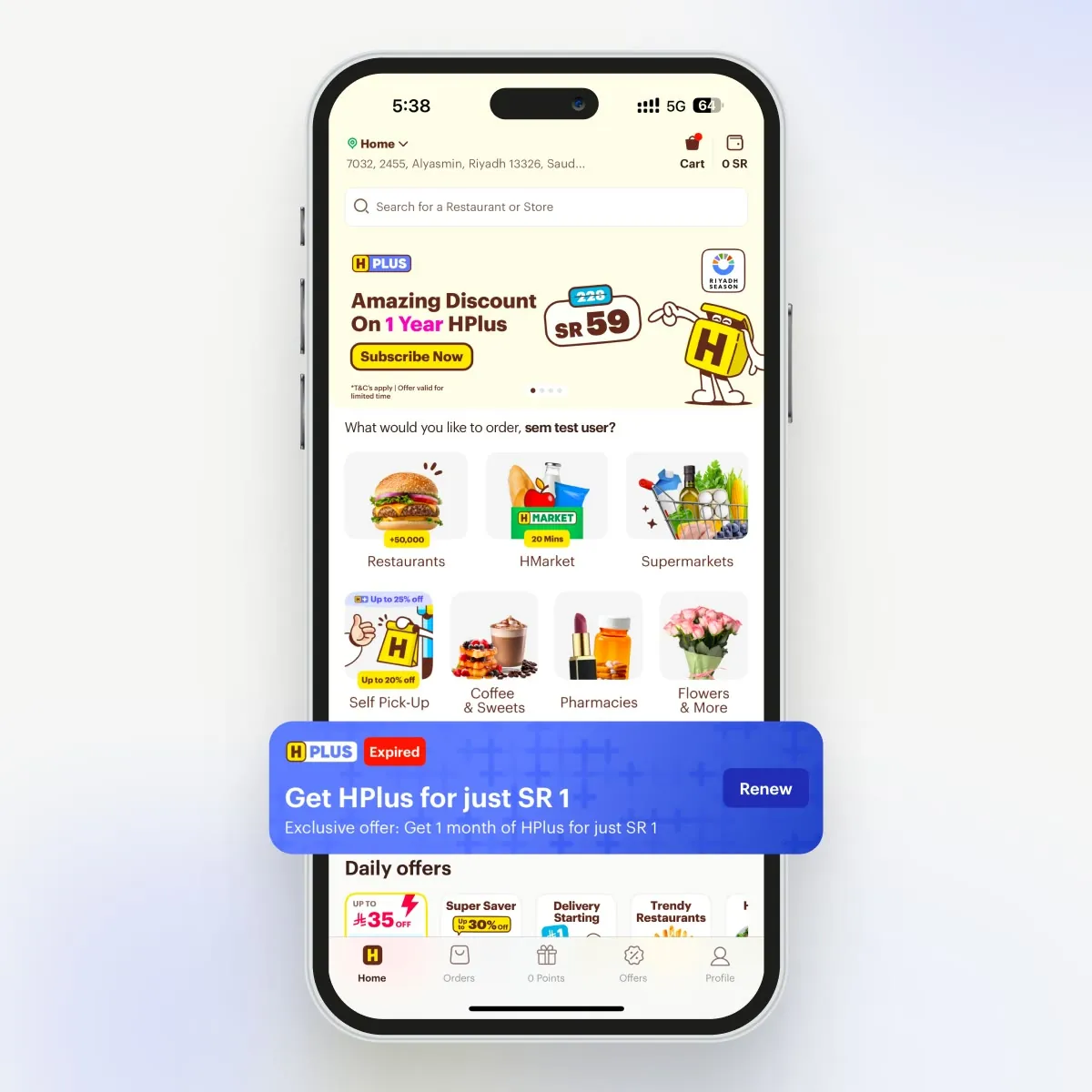
A direct reactivation entry point
The expired state and 1 SR offer were visible on the homepage, close to the user’s next ordering decision.
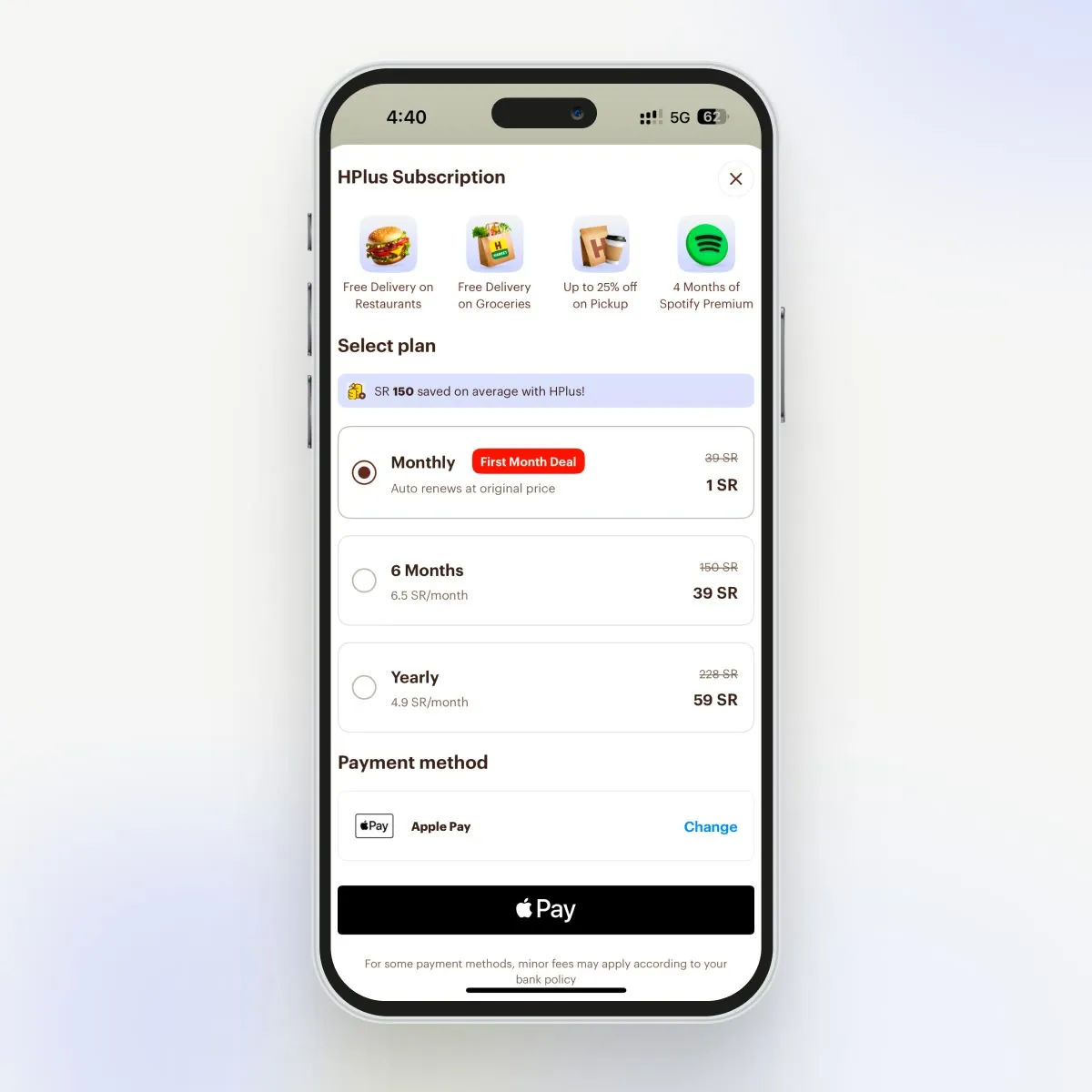
Keep the purchase inside a bottom sheet
I used a bottom sheet so users could compare plans, approve payment, and return to ordering without losing context.
The closer HPlus got to the order, the stronger the conversion.
We expanded the same reactivation logic through restaurant details, cart, and checkout. Each surface made the value more immediate by connecting it to the delivery fee on the current order.
Restaurant details
A compact widget above the primary action replaced larger promotional banners.
Cart
The message showed the exact delivery fee the user could avoid on that order.
Checkout
We repurposed the existing HPlus summary component near the final payment action.
Checkout interstitial
A deliberately high-friction experiment converted far above our expectation.
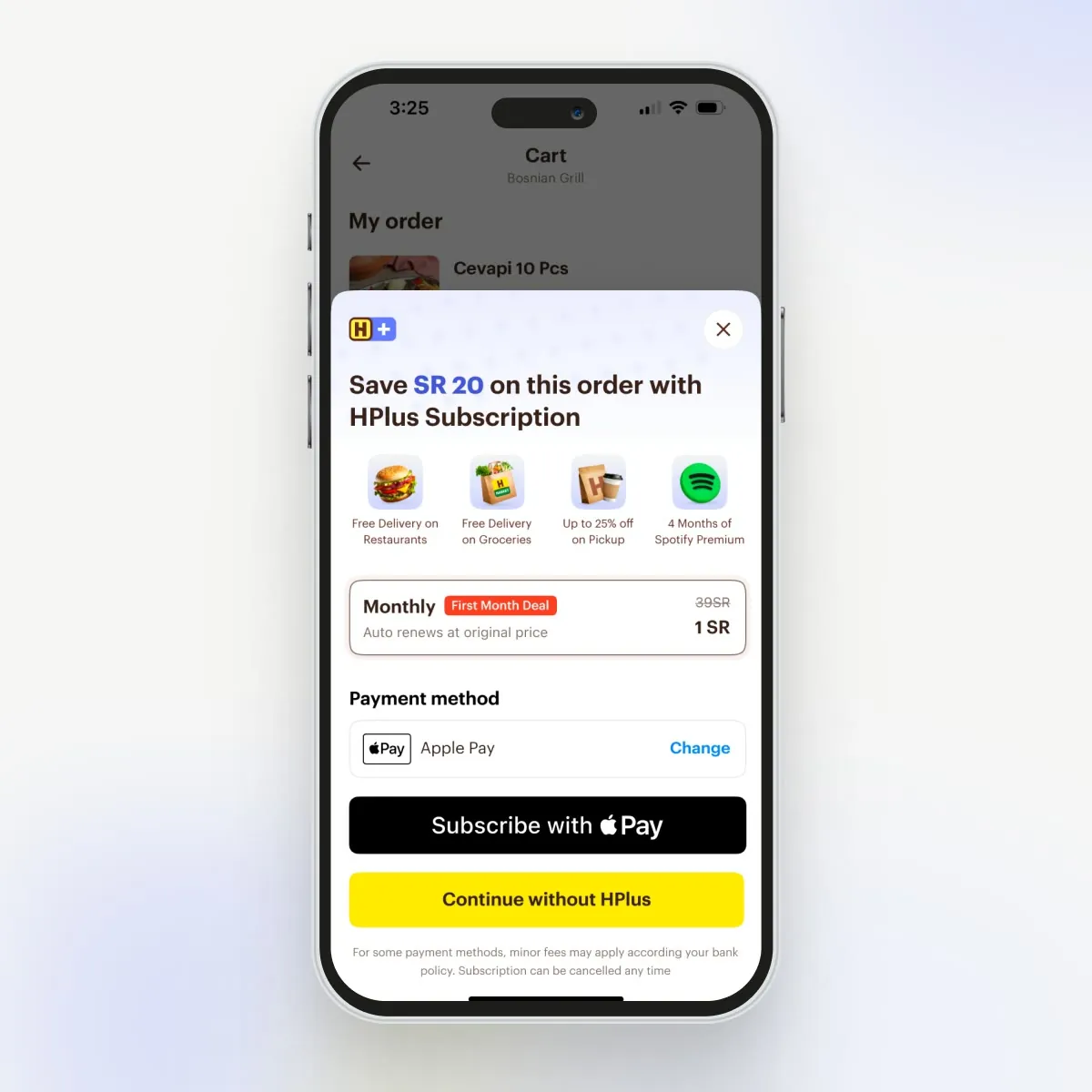
Make the current-order saving explicit
The interstitial showed the amount saved, a preselected 1 SR plan, a clear subscription payment action, and a route to continue without HPlus.
conversion, with a real trust cost
The checkout interstitial worked, but it also caused a roughly 1-2% increase in support contacts from users who thought Apple Pay was completing their food order rather than buying HPlus.
I made the hierarchy and CTA language more explicit, and we aligned with support on immediate refunds for accidental signups. The experiment taught me to treat friction as a product variable, not a rule: conversion only counts when the tradeoff is understood and managed.
A simple add-to-cart idea took two months to ship.
The next move was to let users add HPlus to their cart like any other item. On the surface, it was one button and one new line item. Underneath, the subscription had to remove the delivery fee from the active order, split the payment, create a recurring mandate, and behave correctly when the food order failed or was refunded.
My role was not only designing the component. I worked through where it belonged, how the total should recalculate, what the fallback authorization flow needed to explain, and which operational guardrails made the experience supportable.
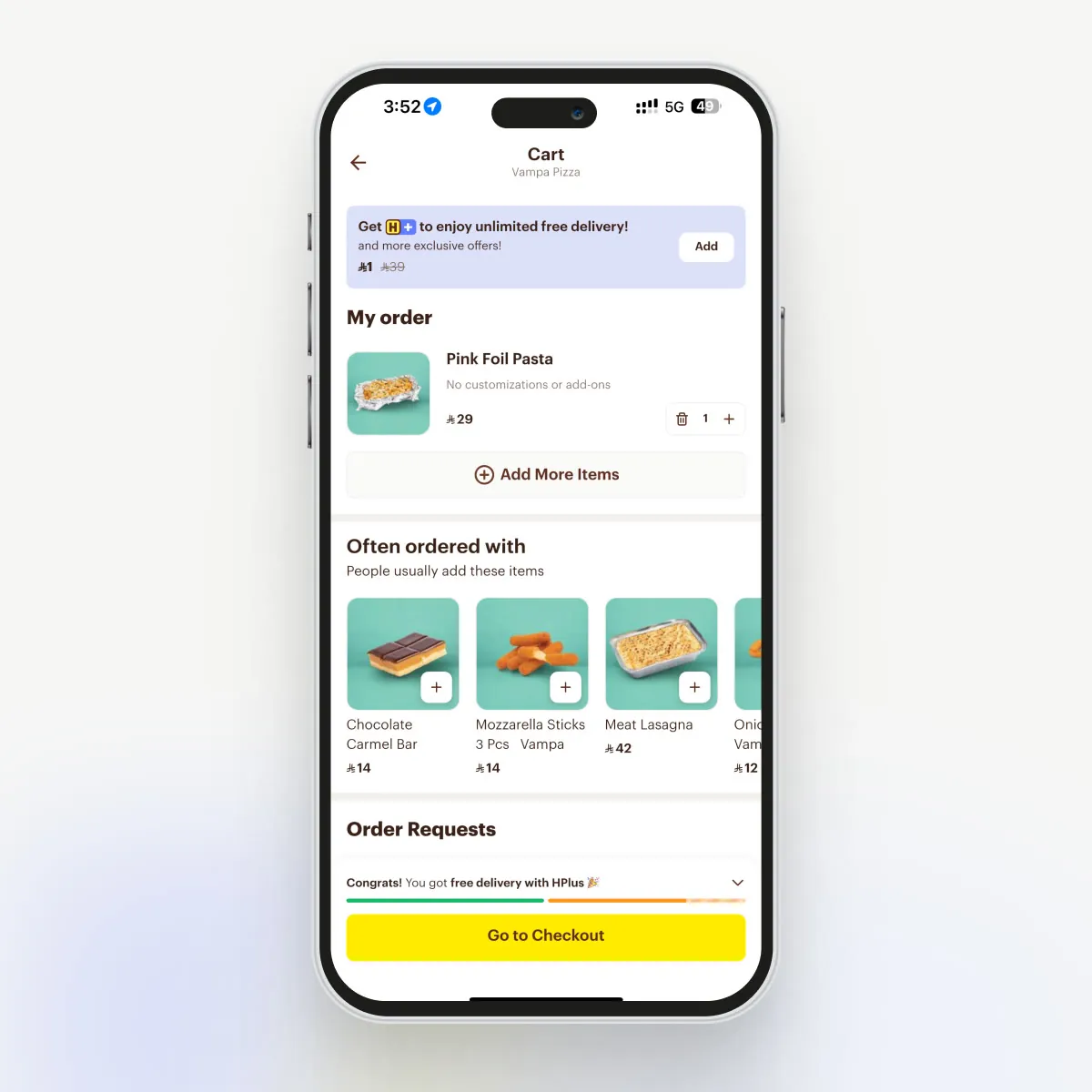
Generic subscription value
One variation led with unlimited free delivery and exclusive offers.
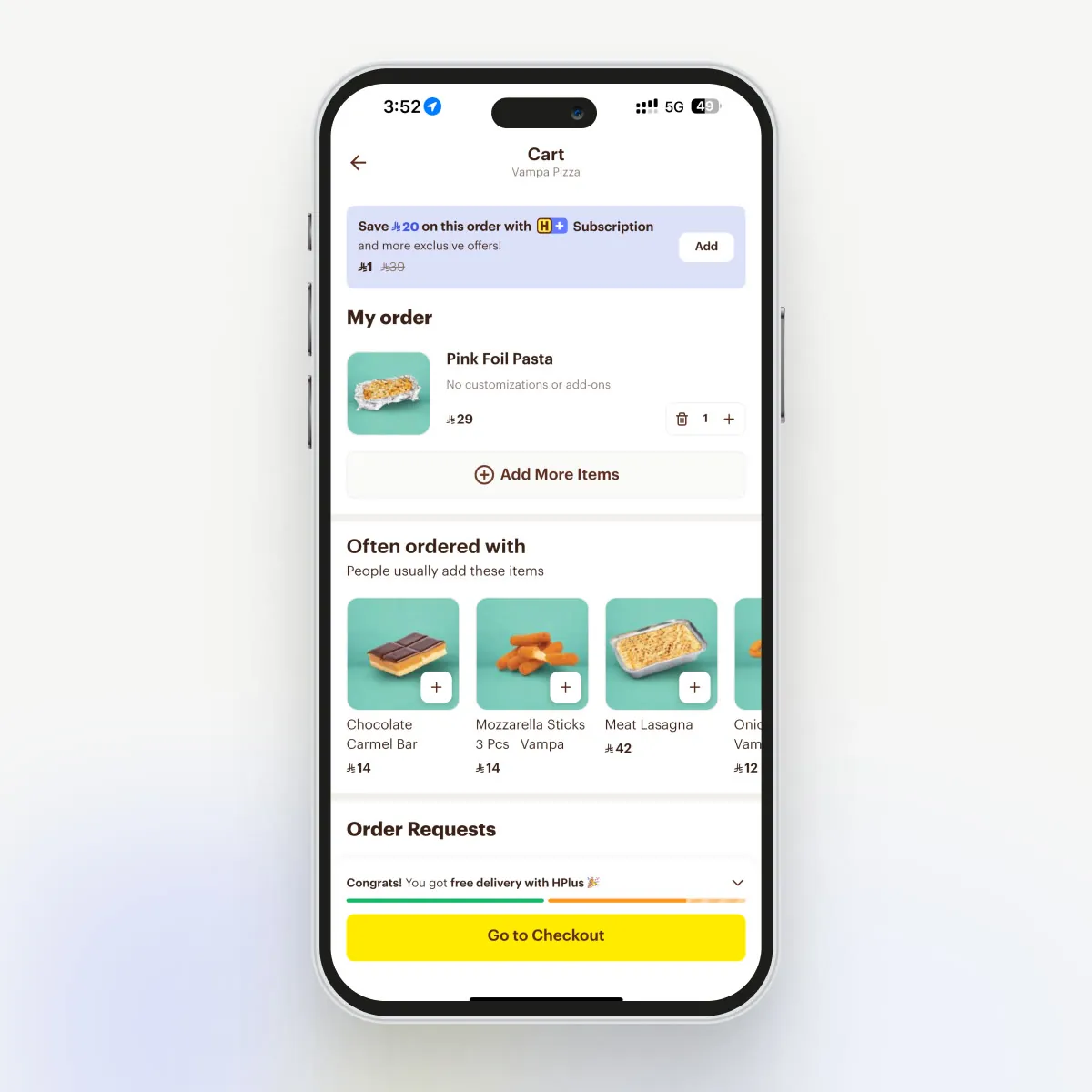
Current-order saving
The contextual variation connected HPlus to the 20 SR saving available on that order.
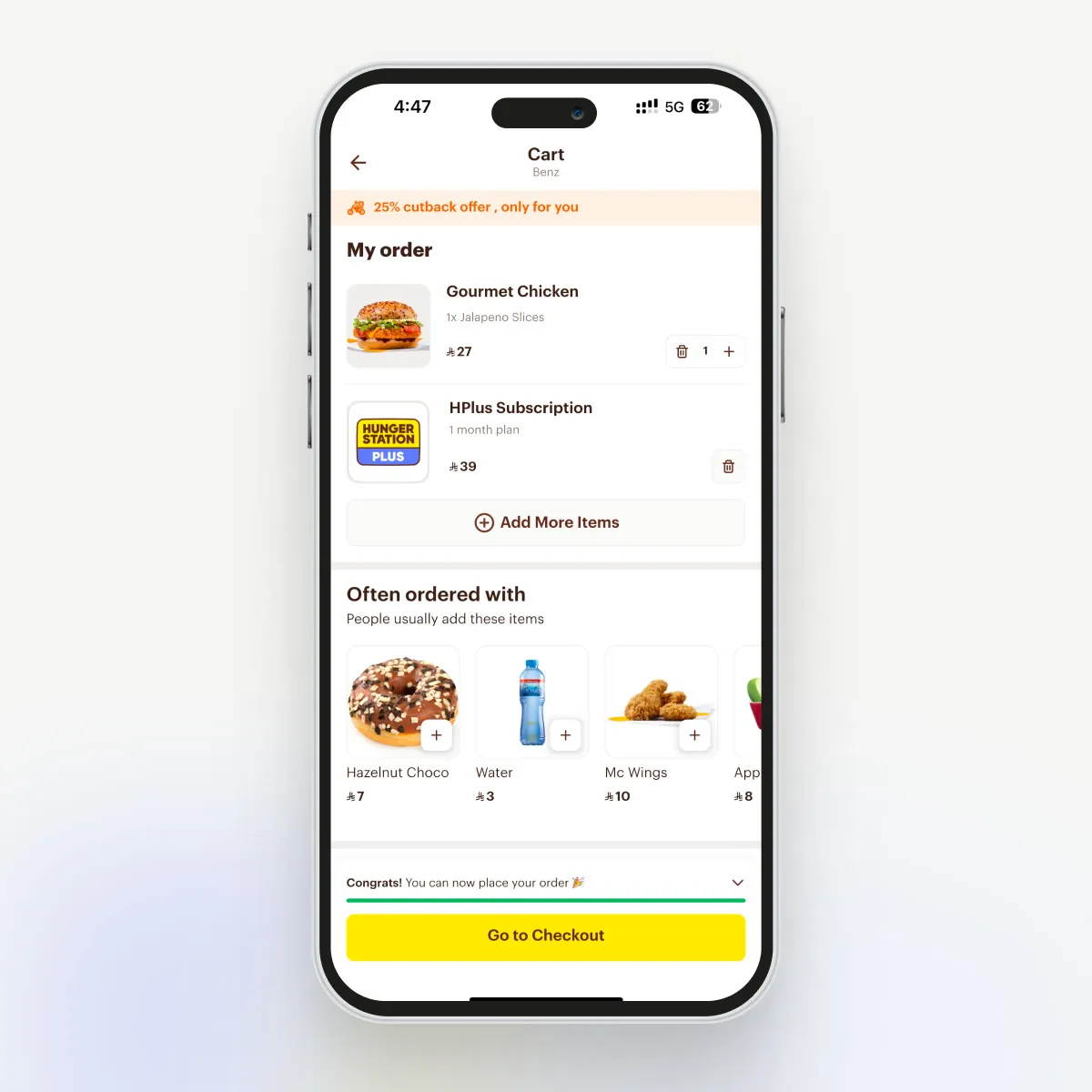
Added-to-cart state
HPlus became a removable line item. The cart did not expose the full fee breakdown; that calculation appeared at checkout.
The visible state was one new cart item. Shipping it meant aligning the behavior behind that item across five parts of the business.
Placement
Find a prominent entry point without obscuring the food order.
Value handoff
Carry the free-delivery benefit into the fee calculation shown at checkout.
Split authorization
Capture the order payment while establishing the recurring subscription mandate.
Failure handling
Define refund behavior when an order fails but the subscription succeeds.
Guardrails
Set controls around repeated trial and cancellation behavior, define the acceptable fraud threshold for the feature, and add kill switches with the fraud teams.
The work connected subscription value to everyday ordering behavior.
Annual HPlus revenue
The subscription program’s annual revenue after the acquisition, retention, and reactivation work.
Average subscription registrations
Up from roughly 600-800 per day, with offer periods peaking near 12,500-15,000 daily reactivations.
What this work changed in how I design growth.
Design where the intent already lives.
The strongest HPlus surfaces did not ask users to manage a subscription. They made the value of subscribing obvious inside an order the user already cared about.
Growth metrics need a trust counterweight.
The checkout interstitial proved that friction can convert. It also made support contacts and accidental purchase risk part of the design problem, not somebody else’s cleanup.
The interface is only the visible layer.
The hardest part of adding HPlus to cart was not the button. It was aligning payment authorization, live pricing, refunds, support, and fraud behavior so the promise on screen stayed true.